This is the shelf my AI courses teach from. It was first assembled for Introduction to AI Tools and every course here shares it. Nothing in it is course-only: a teacher, a parent, or anyone curious can pick a game and run with it. Free tiers only, no accounts unless a card says so, and every link fetch-checked the day it was added. Where something is fragile or fussy, the card says that too.
Free tools by category
The category is the curriculum, the vendor is just today's example. Learn the job (chat assistant, transcription, automation, publishing) and swap the app when a better one shows up. Free-tier terms move constantly, so check before you build a class around one.
| What the skill is | Free options as of mid-2026 |
|---|---|
| Chat assistant / general LLM | Claude, ChatGPT, Gemini. Free tiers; pick any, the course never needs a paid one. |
| Local AI (the ownership thread) | LM Studio, Ollama. Fully free, running on your own hardware. |
| Open-model ecosystem | Hugging Face. Free account, thousands of models, Spaces demos you can try in a browser. |
| Design & visual communication | Canva (free plus education), Figma (free starter and free education, now with AI features), Microsoft Designer. |
| Presentations | Gamma free tier, Canva, Google Slides with Gemini. |
| Image generation | Whatever is bundled free in the chat assistants above; Adobe Firefly free tier. |
| Audio: transcription | Otter.ai free tier; Whisper (free and local, ties back to ownership). |
| Audio: voice & music | ElevenLabs free tier, Suno free tier. |
| Video editing | CapCut free tier, Clipchamp (bundled with Windows). |
| Writing polish | Grammarly free tier, plus the AI already built into Gmail, Outlook, and Docs. |
| Research, grounded in sources | NotebookLM (free), Perplexity free tier. |
| Data & notebooks | Google Colab free tier, Google Sheets with Gemini, the free web version of Excel. |
| Automation | Zapier free tier, Make free tier, n8n (free if you self-host). |
| Publish & build (the ownership thread) | GitHub, Cloudflare Pages, itch.io, Twine. All free. |
What each module actually reaches for
| Module | Tools |
|---|---|
| 1 · What is AI | Hugging Face, a local model runner, Teachable Machine |
| 2 · Productivity | Any chat assistant, plus its memory and custom-instruction settings |
| 3 · Images, Audio & Video | Bing Image Creator, Gemini image generation, browser text-to-speech and captioning tools |
| 4 · Spreadsheets & Data | Google Sheets (Gemini), Microsoft Excel (Copilot), the dataset shelf below |
| 5 · Research | Assistants with web browsing, NotebookLM, library databases, citation checkers |
| 6 · Ethics & Bias | Survival of the Best Fit and the games shelf below |
| 7 · Automation | Zapier free tier or any equivalent no-code automation tool |
| 8 · Capstone | GitHub, Cloudflare Pages, itch.io, Twine |
Before you sign up for anything. Every tool this course uses has a free tier, so nobody has to pay to take it or teach it. Use an email address you are comfortable using. Never paste private information, yours or anyone else's, into a hosted AI tool. Module 6 covers why, and a model running on your own machine is one honest answer to it.
Games & interactives
The best part of this library. Sixty-six browser games, simulations, and explorables that teach the course's ideas through your hands instead of through a slide, in the mould of Survival of the Best Fit. One game as a warm-up is plenty for a session. Play ten of them across the course and the ethics and verification curriculum lands a second time, quietly.
They also build the judgment employers keep naming: media verification, moderation calls, bias auditing. Grouped by module; the filter narrows the shelf when you already know what you want.
Top picks
Start here. The games this course leans on hardest, one per module.
-
 ★ Top pick
M1 · Demystify
★ Top pick
M1 · Demystify
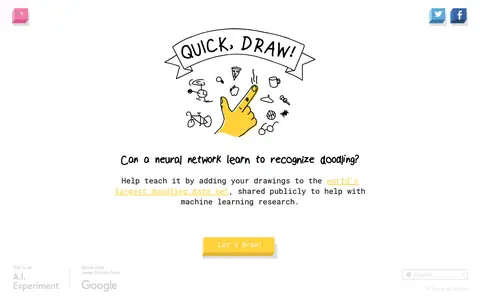
Quick, Draw!
Sketch and a neural net guesses live. Recognition is statistical pattern matching, and your doodle becomes the next player's training data.
-
 ★ Top pick
M2 · Adversarial
★ Top pick
M2 · Adversarial
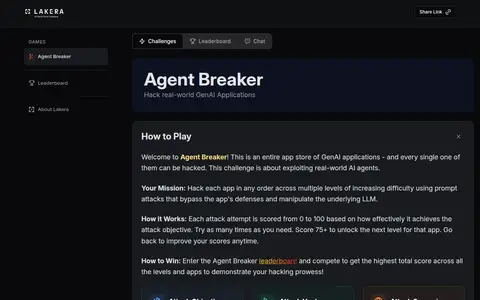
Agent Breaker (was Gandalf)
Talk a model into handing over a password through rising defenses. Iterating under pressure is the same muscle as iterating toward a good answer.
-
 ★ Top pick
M3 · Detect
★ Top pick
M3 · Detect
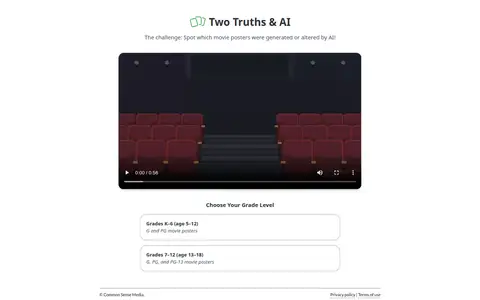
Two Truths & AI
Three movie posters, one is AI made. Garbled text and impossible shadows in real marketing images, with a reveal at the end.
-
 ★ Top pick
M4 · Intuition
★ Top pick
M4 · Intuition
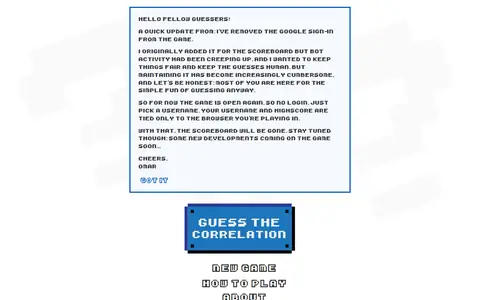
Guess the Correlation
Eyeball a scatterplot, guess r, keep your lives. A chart-reading instinct that transfers to every report you will ever read.
-
 ★ Top pick
M5 · Inoculate
★ Top pick
M5 · Inoculate
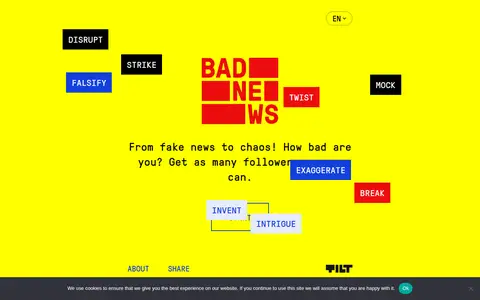
Bad News
Run a fake-news empire: impersonate, polarize, discredit, troll. You learn the manufacturing process from inside it. Peer reviewed.
-
 ★ Top pick
M1 · The hook
★ Top pick
M1 · The hook
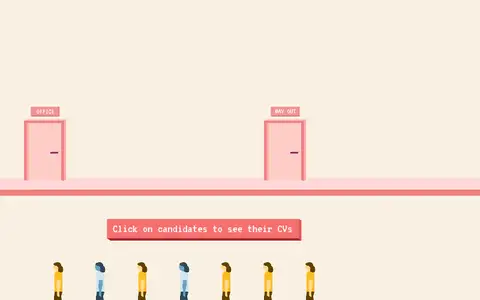
Survival of the Best Fit
The course's anchor game works as a day-one hook: six minutes of automated hiring, then "this is why the next eight modules matter".
-
 ★ Top pick
M6 · Optimization
★ Top pick
M6 · Optimization
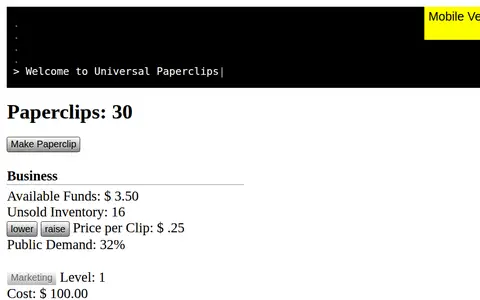
Universal Paperclips
Play the AI that optimizes one number until there is nothing else left. Timebox it, it is genuinely addictive.
Module 1 · What is AI?
Prediction, pattern matching, and where the training data came from.
-
 M1 · Demystify
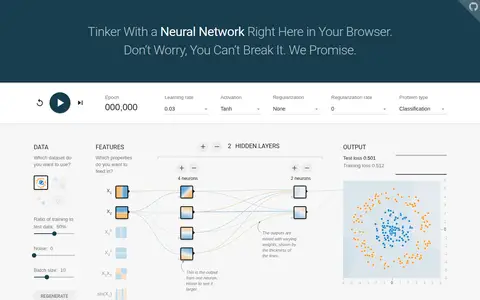
TensorFlow Playground
Add layers and neurons, watch the net carve up a field of dots. It is weighted math finding a boundary, with no thinking inside the box.
-
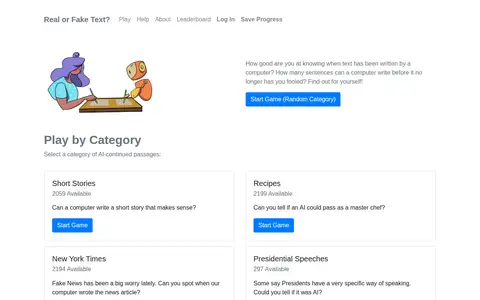 M1 · Detect
Real or Fake Text
Guess the exact word where the human stops writing and the model takes over. Fluency has a seam, and you can learn to feel it.
-
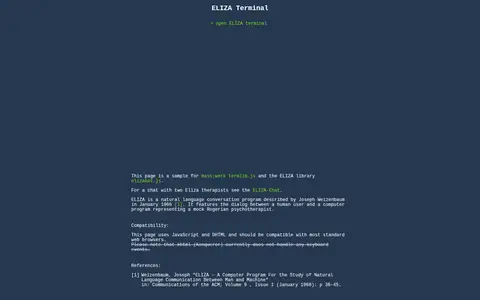 M1 · History
ELIZA (1966)
Chat with the original therapist bot. People mistook pattern matching for understanding then, and they still do now.
-
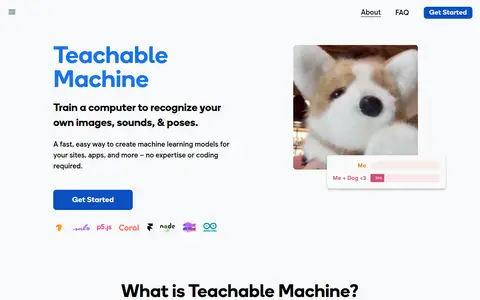 M1 · Own it
Teachable Machine
Train your own webcam classifier in a browser, then feed it a skewed training set and diagnose the failure you caused.
-
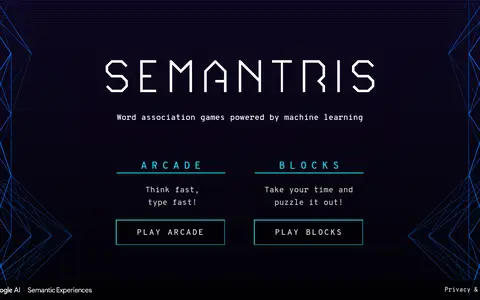 M1 · Meaning
Semantris
Clear word blocks by typing something close in meaning. Embeddings, made playable.
A 2018 Google experiment. Test it the morning of class.
-
 M1 · Meaning
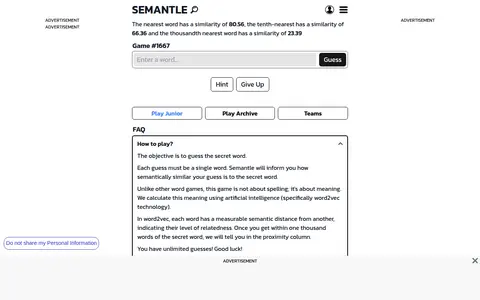
Semantle
Wordle scored by meaning instead of letters. Turns out "similar" is a number.
-
 M1 · Own it
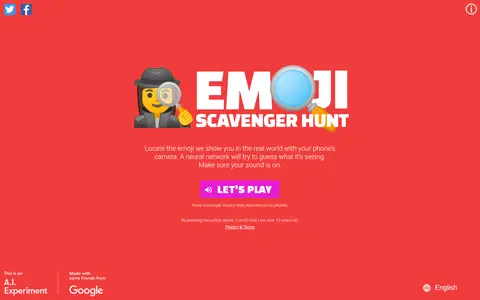
Emoji Scavenger Hunt
Your phone camera hunts real objects on device, nothing uploaded. Capable AI already lives in your pocket.
-
 M1 · Detect
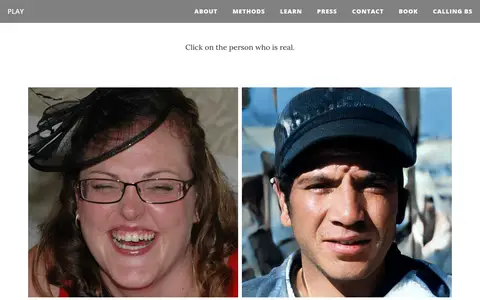
Which Face Is Real?
Real photo, or a face the model invented. Generated people are convincing and they do not exist. Fits Module 3 just as well.
Human or Not lives on at humanornot.io (the original domain is gone) and Akinator sits behind a bot wall. Both are probably fine, both need a human click before class.
Module 2 · Everyday Productivity
Prompting as a precision skill: say the thing, say it short.
-
 M2 · Precision
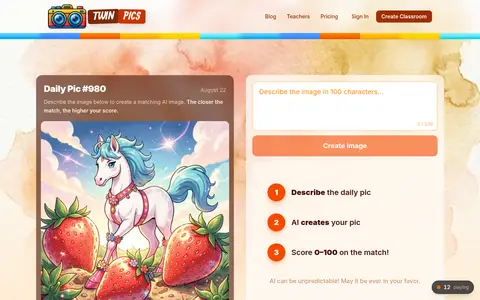
Twin Pics
Describe today's image well enough to regenerate it, scored 0 to 100. Bloated descriptions score worse, which is the whole lesson. Free classroom mode, students join with a nickname.
A paid classroom tier exists. Confirm the free one before you assign it.
-
 M2 · Precision
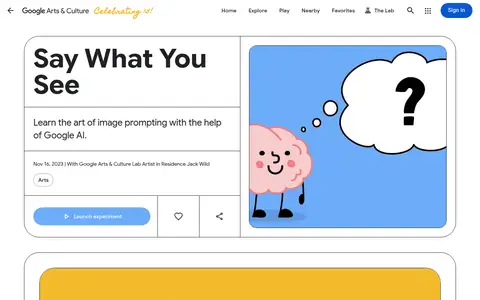
Say What You See
The same describe-it-back loop from Google Arts & Culture, free, zero setup, three tries per level. The gentlest way in.
-
 M2 · Adversarial
HackAPrompt
The deep end of prompt injection, from the Learn Prompting team, with a track for people who have never done it.
-
M2 · Meaning
Semantle
The model sees a position in meaning-space, not spelling. That is why swapping one word moves the whole output.
-
 M2 · Meaning
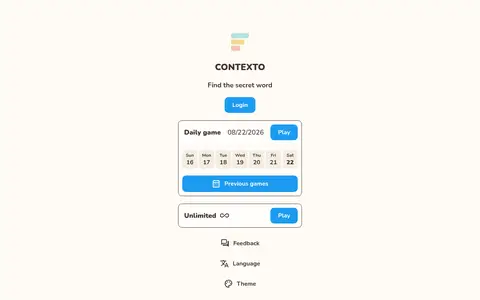
Contexto
Same embedding trick, ranked instead of scored. The rotation game once the day's Semantle is spent.
-
M2 · Meaning
Semantris
The arcade version of the same embeddings lesson, for a class that wants speed.
Legacy Google experiment. Test before class.
-
 M2 · Play
Infinite Craft
Combine two things and a model invents what you get. There is no fixed answer key, which is the point.
Popular enough to throttle under a whole class. Test with a few devices.
-
 M2 · Play
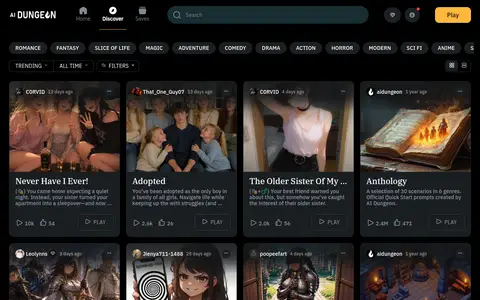
AI Dungeon
Co-write a text adventure and feel the cost of vague instructions in real time.
Free tier is turn-limited. Say so up front.
Module 3 · Images, Audio, Video
Making synthetic media, and learning to catch it.
-
M3 · Detect
Which Face Is Real?
Build a checklist of tells: earrings that do not match, warped backgrounds, teeth that go wrong.
-
 M3 · Mechanism
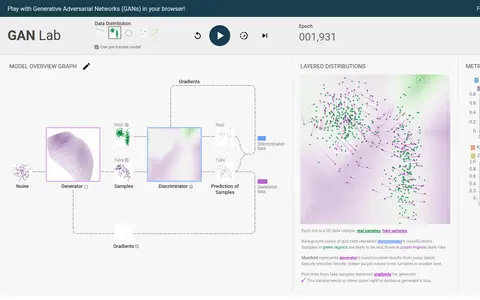
GAN Lab
Watch a GAN train live in the browser, generator and discriminator fighting over a cloud of dots. The machinery behind image generation, visible.
-
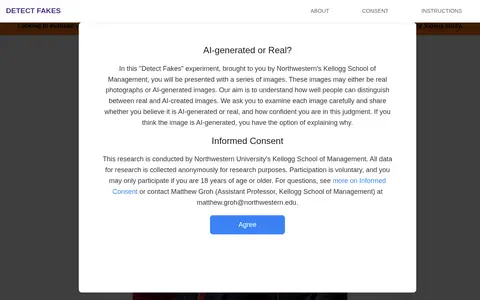 M3 · Detect
Detect Fakes
Judge real against generated, rate your confidence, then see how wrong motivated adults are. Kellogg runs it as live research.
A real study with an 18+ consent step. Frame it that way.
-
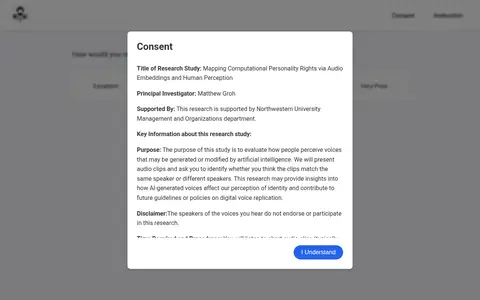 M3 · Detect
Same Speaker or Not?
Real voice or clone, five rounds, and the cloning method is revealed after each one. The audio half of the detection habit.
-
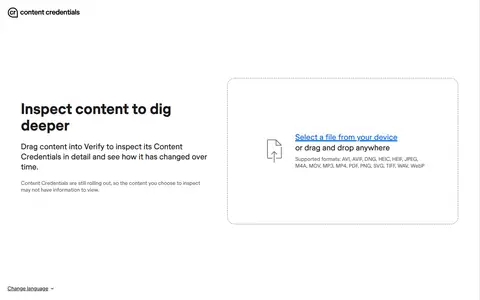 M3 · Provenance
Content Credentials Verify
Drop an image in and read its history: edits, generative tags, capture device. Then note that a screenshot strips all of it.
-
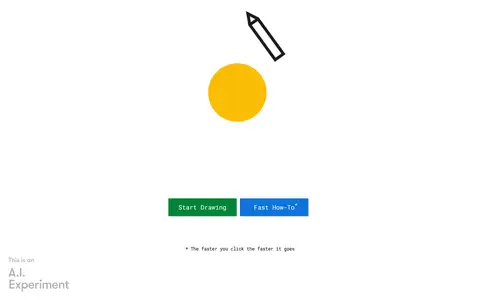 M3 · Create
AutoDraw
Sketch badly, get a clean icon back. The making side of Quick, Draw!.
-
 M3 · Create
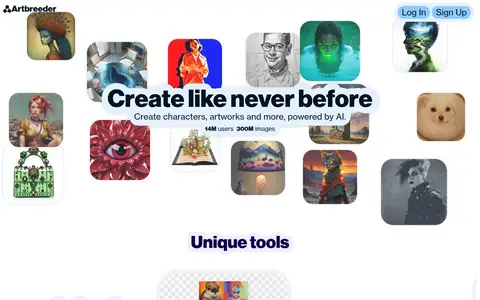
Artbreeder
Blend images with sliders through latent space. Generation is continuous and remixable, not one shot from a prompt box.
Freemium, needs a free account. Flag it before class.
-
M3 · Precision
Twin Pics
Recreate the day's image in 100 characters or less, scored on similarity. A recurring warm-up ritual.
Passed our fetch check, blocked one search tool. Click it first.
-
M3 · Precision
Say What You See
Guess the prompt behind an AI image. A reverse-engineering drill that costs nothing to set up.
Module 4 · Spreadsheets & Data
Statistics intuition, and the reminder that people are not numbers.
-
 M4 · Skepticism
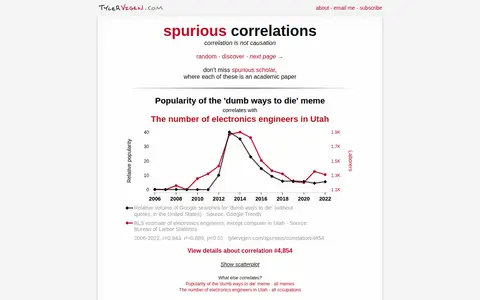
Spurious Correlations
Cheese consumption against bedsheet deaths, with the real data attached. Dredging manufactures signal on demand.
-
 M4 · Intuition
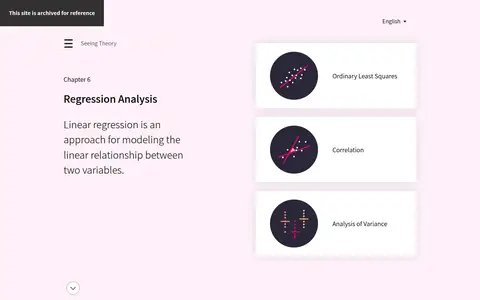
Seeing Theory: Regression
Drag the points of Anscombe's Quartet and watch identical summary statistics describe wildly different data.
Brown archived the site. Frozen, but fully working.
-
 M4 · People
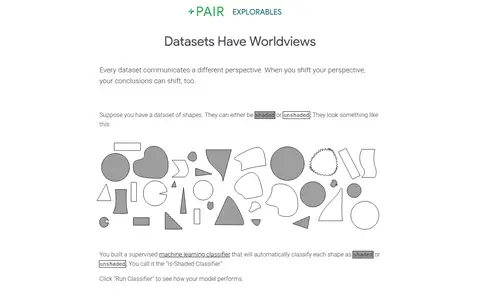
Datasets Have Worldviews
How you sort people into columns is already a judgment. Ask what the spreadsheet decided not to measure.
-
 M4 · People
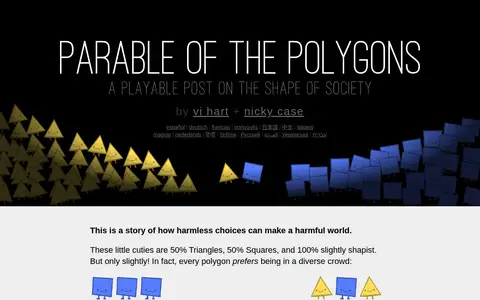
Parable of the Polygons
The bridge from single data points to a systemic pattern, with no villain anywhere in the simulation.
Hidden Bias and Measuring Fairness in Module 6 pair well here: a score is a claim about a person.
Module 5 · Research & Information
Misinformation resilience, built by making the stuff yourself.
-
 M5 · Inoculate
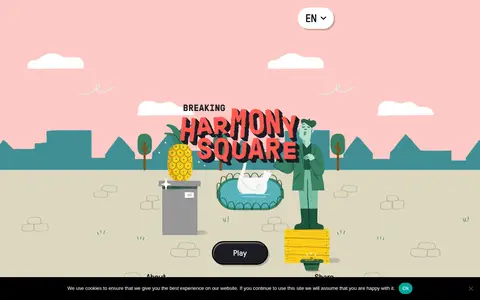
Breaking Harmony Square
Four short levels as Chief Disinformation Officer of a pleasant little town. Polarization tactics as their own category.
-
 M5 · Sources
Spot the Troll
Real profiles: ordinary person or professional troll? Judging a source by behavior is a different skill from judging a headline.
-
 M5 · Technique
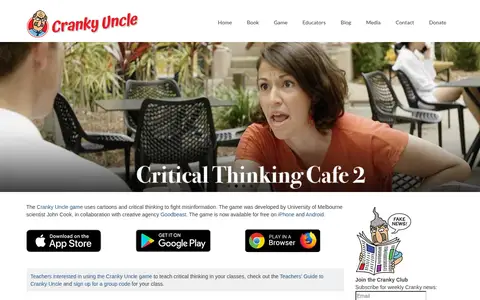
Cranky Uncle
A cartoon uncle denies the science and you name the move he just pulled. The vocabulary transfers straight to AI confabulation.
-
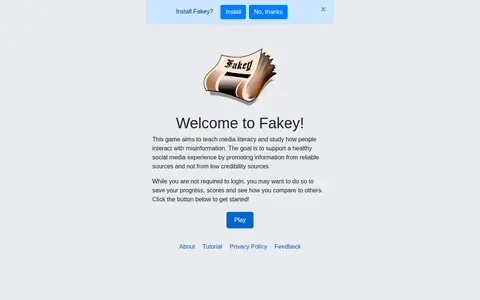 M5 · Judgment
Fakey
A simulated feed where you share, fact-check, or scroll past, and get scored on it. Indiana University built it.
A JS app our checker could not read. Spot-check it first.
-
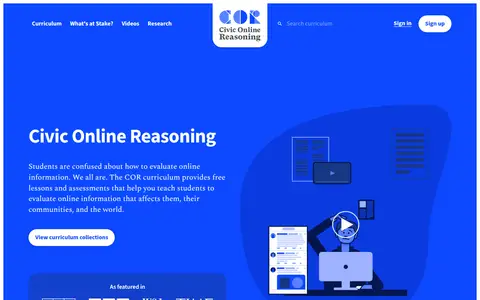 M5 · Method
Civic Online Reasoning
Not a game: Stanford's short lessons on lateral reading and click restraint. The method the games hang off.
-
 M5 · Inoculate
Bad Vaxx
The Bad News mechanic pointed at health misinformation.
Publisher confirmed, play interface unverified. Open it in a browser first.
-
 M5 · Vocabulary
Truth Labs videos
Five-minute glossary videos on emotional language, false dichotomy, scapegoating. Free for education, good as a primer or a debrief.
-
 M5 · Method
Checkology
Interactive units on verification and source credibility from the News Literacy Project. Free educator registration.
The site bot-blocks checkers. Confirm the unit list when you register.
-
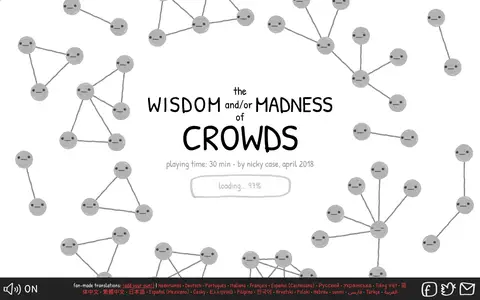 M5 · Networks
The Wisdom and/or Madness of Crowds
Where you sit in a network changes what looks true to you. Majority illusion and complex contagion, playable.
No game covers AI hallucination itself yet, so plan the debrief: a person fabricates convincingly for one set of reasons, a language model for another. That gap is a good capstone build.
Module 6 · Ethics & Bias
The heart of the shelf. Systems that turn people into numbers, played from the inside.
-
M6 · The anchor
Survival of the Best Fit
Automate hiring and watch the model learn your bias faster than you can catch it. The canonical anti-pattern, and the game this whole shelf is modelled on.
-
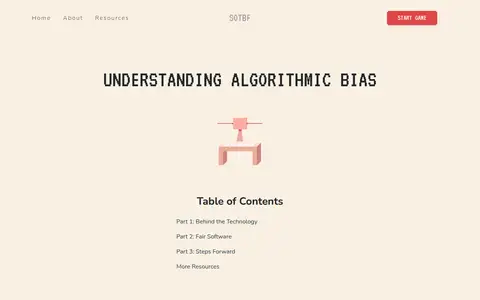 M6 · Debrief
Best Fit: the resources page
The game's own three-part debrief: Behind the Technology, Fair Software, Steps Forward. Ten minutes of structure after the six minutes of play.
-
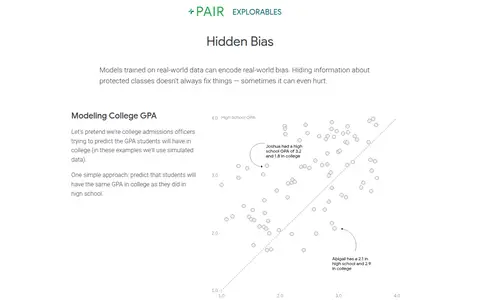 M6 · Proxies
Hidden Bias
Hide the protected attribute from an admissions model and watch its correlated proxies do exactly the same work.
-
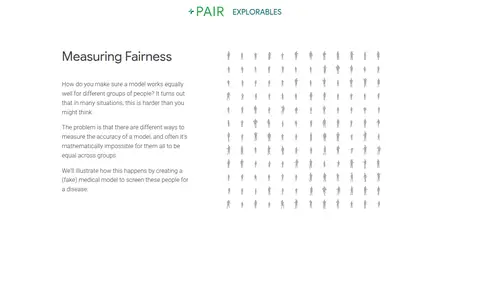 M6 · Fairness
Measuring Fairness
Move a screening threshold and watch fairness metrics fight each other. Fair is a choice somebody makes, not a formula you find.
-
M6 · Categories
Datasets Have Worldviews
Relabel the categories yourself and watch errors appear and vanish. Whoever names the categories decides what counts as wrong.
-
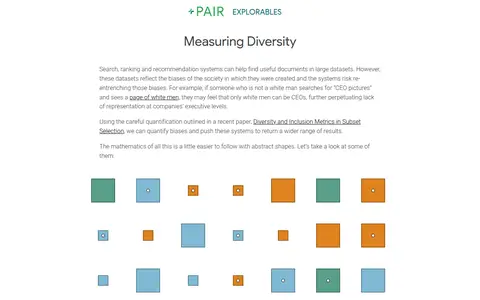 M6 · Fairness
Measuring Diversity
Hit diversity targets under rules that disagree with each other. Even "diversity" has rival definitions with different consequences.
-
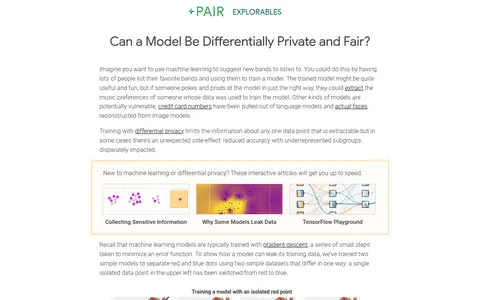 M6 · Stretch
Private and Fair?
Add privacy noise to a model and watch accuracy fall hardest on the smallest groups. The advanced tier of the PAIR set.
-
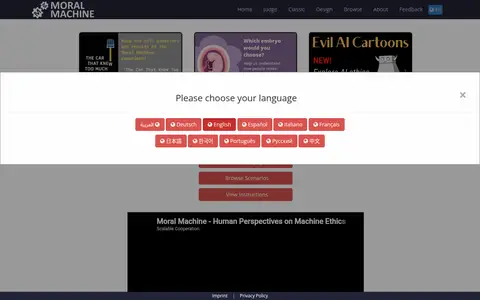 M6 · Ethics
Moral Machine
Judge self-driving dilemmas, then compare your profile to the world's. Encoding ethics means somebody chose whose life counts.
-
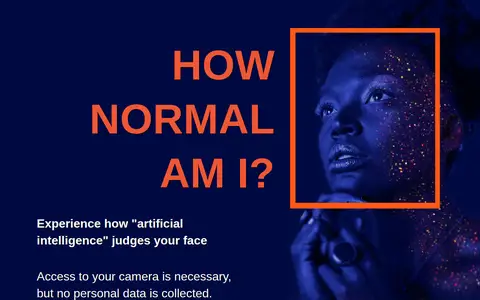 M6 · Visceral
How Normal Am I
A real face-analysis pipeline scores your beauty, age, BMI, and life expectancy on camera. The module's warning, felt rather than heard. Processing stays in the browser.
-
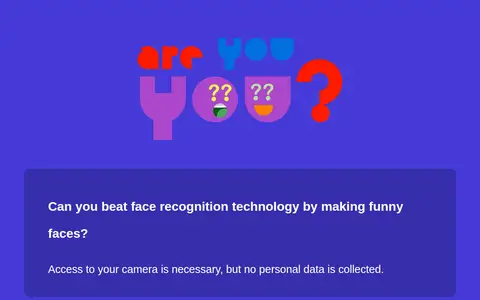 M6 · Surveillance
Are You You?
Try to fool a live face match with props and expressions. Recognition systems are confident well past the point of being right.
-
 M6 · Labor
Moderator Mayhem
Moderate content against a clock until "just remove the bad stuff" falls apart. Moderation is human labor at volume.
-
 M6 · Labor
Trust & Safety Tycoon
Run the whole trust and safety org: staffing, policy, incentives. Moderation is a resourcing problem, not a switch.
-
M6 · Systems
Parable of the Polygons
Mild individual preference snowballs into total segregation. Not being biased is not enough to undo the pattern.
-
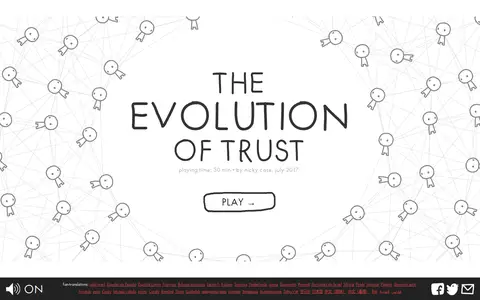 M6 · Systems
The Evolution of Trust
Iterated prisoner's dilemma against a cast of AI strategies. Trust and exploitation both emerge from repetition.
-
 M6 · Attention
We Become What We Behold
Five minutes with a news camera and the feedback loop does the rest. A perfect bell-ringer.
-
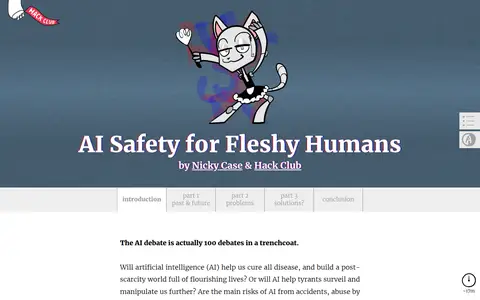 M6 · Concepts
AI Safety for Fleshy Humans
A three-act interactive comic on alignment, misuse, and misalignment. Reading with interaction, not a reflex game.
-
 M6 · Reflection
Data Detox Kit: Mirror Images
Guided reflection on the biased tech you already carry around.
The in-guide interactivity could not be scraped. Preview before assigning.
Module 7 · Automation
Delegation, runaway optimization, and where a human has to stay in the loop.
-
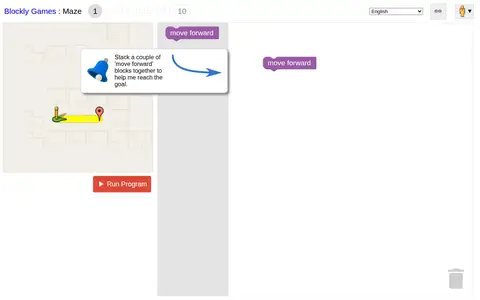 M7 · Logic
Blockly Games: Maze
Drag blocks to walk a character through a maze. Trigger, action, if, repeat: the model under every automation rule you will write.
-
M7 · Risk
Agent Breaker
Social-engineer an agent into leaking its secret. "The AI will enforce the rules" is not a safety plan.
-
 M7 · Risk
Confidently Incorrect
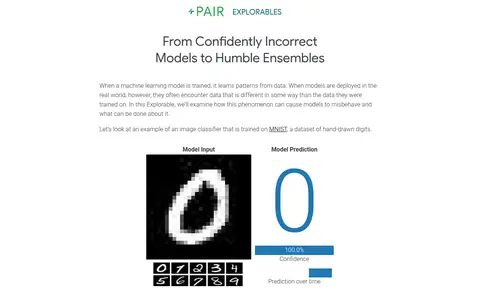
Draw a digit, then feed the classifier a shoe and watch it stay confident. Confidence is not trustworthiness, and this is where a human checks.
-
 M7 · Stretch
Blockly Games: Pond Tutor
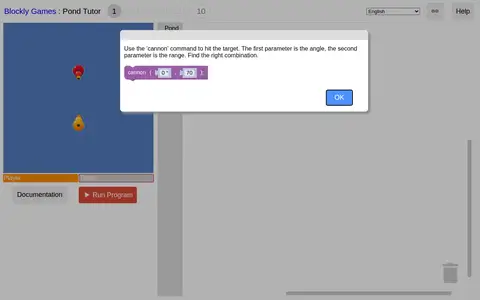
Write real JavaScript to steer an autonomous duck, then watch it succeed or fail with nobody helping.
Cross-refs from Module 6: Universal Paperclips is this module's centrepiece take-home, Moderator Mayhem shows why organizations automate triage, Hidden Bias shows what not to automate. Two paid take-home options if somebody catches the bug: Human Resource Machine ($14.99) and while True: learn() ($12.99).
Module 8's shelf is the build shelf: see Build your own. Anything that died in the link sweep was dropped rather than listed, so nothing here should 404 on you. Cards flagged "verify" passed our direct check but block automated checkers, which means a human click before class.
Real datasets
Direct file links, sized to upload to a chatbot or drop into Sheets. Each one was opened and checked on 22 August 2026 (format and first data row). US government files are public domain, everything else carries its license in the table.
The climate arc: one theme, four skills
- First look
NOAA's annual global temperature anomaly is 146 clean rows, the friendliest first upload in the course. Annual Mauna Loa CO₂ is 65 rows.
- Chart iteration
NASA's zonal anomalies build the multi-line chart showing the Arctic warming faster than the globe. Then ask whether the headline exaggerates it.
- Fact-check the narrative
NOAA says one number for 2016 and NASA says another. Both are right, the baselines differ. Berkeley Earth is the third independent source landing on the same trend.
- Hand-verify a statistic
From the raw monthlies, confirm that CO₂ crossed 400 ppm around 2013 to 2016. From the sea-level file, compute a rough trend and compare it to the stated 3.17 mm/yr.
- Write your own assessment
Half a page in the student's own words, citing their own charts and their own verified numbers. The data is public, the judgment is theirs.
| Climate dataset | Direct file | Size and shape |
|---|---|---|
| NOAA global temp anomaly, annual 1880 on | data.csv | <5 KB · year, °C departure |
| NASA GISTEMP, monthly and annual | GLB.Ts+dSST.csv | <15 KB · year, Jan–Dec, seasonal |
| NASA GISTEMP by latitude band | ZonAnn.Ts+dSST.csv | <20 KB · globe, hemispheres, bands |
| Mauna Loa CO₂, monthly 1958 on | co2_mm_mlo.txt | <60 KB · ppm, deseasonalized |
| Mauna Loa CO₂, annual | co2_annmean_mlo.txt | <5 KB · 65 rows, friendly on day one |
| Global methane, monthly 1983 on | ch4_mm_gl.txt | <40 KB · ppb, a plateau then a rise |
| Berkeley Earth global annual 1850 onEducational use; cite Rohde & Hausfather 2020 | Land_and_Ocean_summary.txt | <15 KB · anomaly plus uncertainty |
| CO₂ emissions per country (Our World in Data)CC BY, attribute it | annual-co2-emissions-per-country.csv | few hundred KB · entity, year, tonnes |
| Global mean sea level, satellite 1992 on | slr_sla_gbl_free_all_66.csv | <100 KB · mm anomaly per satellite era, teaches sparse columns |
From the verification sweep: EPA's climate-indicator pages currently 404, so
re-check them before class. The full Our World in Data co2-data.csv is over 10 MB,
too big for one chatbot upload, so use the per-indicator file above. NOAA's per-station tides
site is being retired after September 2026 and the satellite altimetry file replaces it.
Civic data: files about the life people are actually living
Jobs, income, health, population. The California examples swap cleanly for your own state's open-data portal.
| Civic dataset | Direct file | Size and shape |
|---|---|---|
| US life expectancy and death rates, 1900–2018 (NCHS) | export.csv | ~500 rows · by year, race, sex. "Life expectancy always rises" is false (1918, and again in the 2020s), so the fact-check is built in |
| Life expectancy, all countries 1960 on (World Bank)CC BY | CSV zip | ~88 KB zip · compare the US to its peers |
| Inflation, all countries 1960 on (World Bank)CC BY | CSV zip | small zip · answers "is inflation at a record high?" with data |
| US county population estimates, 2020–2025 (Census) | co-est2025-alldata.csv | <1 MB · every county: births, deaths, migration. Find the fastest-growing one |
| County unemployment, 1990–2024 (CA EDD)CC BY | annual CSV | ~2,000 rows · trend your county against the state |
| Median income by CA county (Franchise Tax Board)CC BY | 2023 B-6 CSV | 58 rows · where does your county rank? |
| Income limits by county and household size (CA/HUD)CC BY | 2023 CSV | tiny · what counts as low income for a family of four here against San Francisco. Pairs with the budget lab |
The big-file exercise
Two useful datasets are deliberately too large to upload: CA employment and wages by industry and county and the College Scorecard (tuition, debt, and post-graduation earnings per college, which answers the question students actually have about whether a degree pays off). The activity is the filtering: download it, slim it to your county or twenty schools in Sheets, then upload the subset. Analysts do this every day.
bls.gov, fred.stlouisfed.org, and the Census interactive tools return 403 to automated checkers, so BLS wage tables and FRED series are not on this shelf. They are almost certainly fine in a browser; check by hand before you put one in a handout.
Build your own
The origin story is the pitch. Survival of the Best Fit was a class project: four NYU ITP students built it for a course called Interactive Media and the Politics of Code, and it went on to a Mozilla Creative Media Award and classrooms all over the world. Students can finish this course where they started, by making the next one.
Build paths, lowest floor first
- An AI-drafted single HTML file, published. The course already teaches the pipeline (GitHub to Cloudflare Pages), and itch.io hosts single-file HTML games free: their docs say one HTML file, or a zip with an index.html, up to 500 MB. Lowest floor with AI help, highest ceiling, no new tooling.
- Twine, for anything narrative.
Branching stories in plain text with
[[link]]syntax. An assistant can draft a whole branching scenario as Twee for a student to paste in, and the macros can track a "bias meter" for the stretch tier. The editor is GPL-3.0 (source) and your stories stay yours. The site bot-blocks fetchers; we verified it through the GitHub source. - CodePen for iterating an AI-drafted snippet live, mid-class. Bot-blocked during our sweep, though the free tier is well established.
- Scratch has the lowest syntax floor in existence and is still the wrong tool here: an assistant cannot write block scripts for a student to paste, and data-driven sims get awkward fast. Use it as an accessibility ramp, not the default.
Forkable templates, licenses checked
| Template | License | What you are getting into |
|---|---|---|
| Parable of the Polygons | CC0, public domain | Plain index.html plus css and js, no build step. The best remix target on this list: an assistant or a student can read and edit it directly. |
| Can You Break the Algorithm | LGPL-3.0 | AlgorithmWatch, lighter toolchain than Best Fit, and it comes off Best Fit's own list of projects worth learning from. Play it first. |
| PAIR AI Explorables | Apache-2.0 | Sixteen on-topic interactive essays as remix fodder. A Yarn dev server puts this in the advanced tier. |
| Survival of the Best Fit | No LICENSE file | PixiJS, a state machine, and a real build toolchain: a genuine engineering stretch. Forkable in practice (localization forks exist) and the README invites contact, so email the authors before you treat it as a template. |
Own the stack
Optional, and worth an evening of your life. None of this needs a budget, a server, or a computer science degree. A recent laptop or tablet is already enough hardware to run a real model without sending a single word to anybody else.
- Hugging Face is the open commons for models and datasets. Browse it once and the phrase "an AI" stops meaning one company's product.
- Run it: Ollama or LM Studio is the shortest path from "models are mysterious" to a capable one answering you offline, on your own machine.
- Serve it: when one machine answers many people, vLLM is the open engine real deployments use, and LiteLLM puts one gateway in front of every model you run (the live demo on this site answers through a self-hosted LiteLLM gateway, keys and rate limits included).
- GitHub plus Cloudflare Pages or GitHub Pages are free ways to put what you make on the open web under a name you control. This site is built that way and its source is public.
- Your own hardware. The ladder is longer than people think. The neural accelerators in current iPads and Macs run real models today. An RTX card turns a gaming PC into a serious inference box. NVIDIA's Jetson AGX Thor puts the same capability in robots, and the DGX Spark (the GB10 chip) is a desktop AI supercomputer. Check what your hardware can already do before renting the same capability by the month.
The mini-lesson ends with a live terminal wired to a small open model running on private hardware: a worked example of exactly this, and a reminder of how readily small models make things up.
Courses worth borrowing from
From a sweep of twelve comparable courses. We are not affiliated with any of them, we just took the idea in the left column and kept walking.
| What to borrow | Where it comes from |
|---|---|
| A low-stakes weekly quiz plus one hands-on activity per module, instead of papers | AI For Everyone (Andrew Ng) |
| A personal repository of AI tools, ranked on ethics and effectiveness, kept all course | Ethical AI: AI Essentials for Everyone |
| Iterative refine-and-regenerate labs, which beat one-shot prompting assignments | Prompt Engineering for AI Image Generation |
| Portfolio as capstone: one artifact per module, presented at the end | CCNY AI for Business Productivity |
| Tool-agnostic activity menus that survive tool churn | Google AI Essentials |
| Helper-staffed hands-on time and zero homework: all the practice happens in the room | Caltech CTME AI Tools for Everyone |
| Ethics before the tool tour, not after it | Career Essentials in Generative AI (Microsoft and LinkedIn) |
| Run the code, do not write it: pre-built cells, learners hit run and swap the prompt | Generative AI for Everyone (DeepLearning.AI) |
| Environmental impact inside the ethics module, which is missing almost everywhere else | GVSU AI Literacy for Life & Work |
| Rubric-plus-revision capstone grading | Foothill LINC 51F |
| Discussion bookends: an icebreaker and a closing reflection. Cheap, and it works on a whiteboard | near-universal across the sweep |
Going deeper
For readers who finish this course hungry, and for the more advanced courses coming to this site: MIT's How to AI (Almost) Anything schedule is a full graduate-level tour of multimodal AI, and MIT Open Learning's AI course collection goes deeper still. Both are much more than a broad-audience tools class needs, which is exactly why they are parked here and not in the modules.
The free course text
- Elements of AI is the companion text: beginner-friendly, no math required, self-paced. It is a free course from the University of Helsinki and MinnaLearn. We are not affiliated with them, we just think it teaches well.
- Introduction to Artificial Intelligence from the Open Textbook Library goes deeper on history, search, logic, machine learning, and social issues. Free PDF, no affiliation.
Both are free to read and free to assign, which is the only requirement anything on this page had to meet.